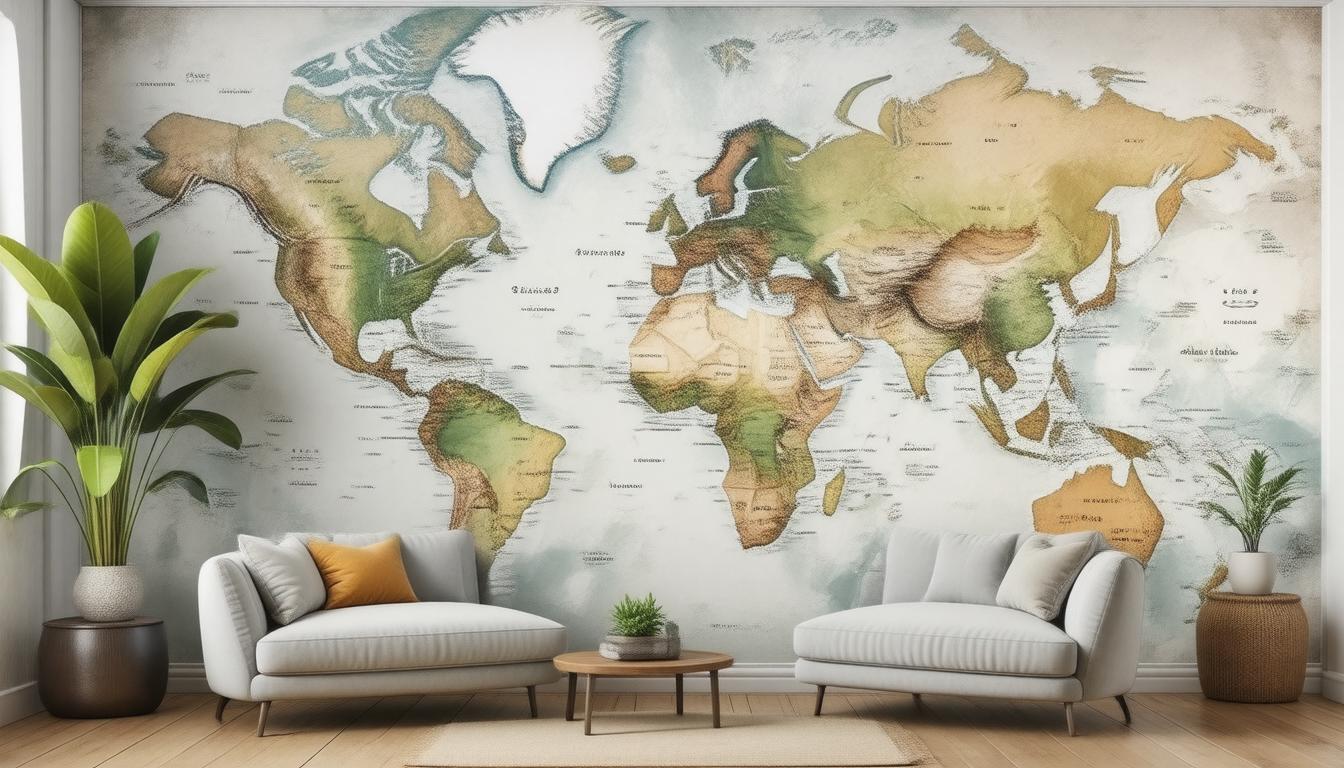
Map wall decals can add geographic context, a sense of travel or a structured focal point to a room. The best result depends on more than choosing an attractive map. Scale, label detail, wall condition, viewing distance and artwork rights all affect whether the finished display is clear and suitable for its setting.
Choose the purpose before the map style
Start by deciding what the map should do. A decorative outline map creates a calm graphic element. A labeled map supports reference and discussion. A local street plan can connect a room to a city or neighborhood. A custom route map can mark journeys, offices or event locations.
If the decal will be used for teaching or navigation, verify names, borders, dates and scale with an authoritative source. Decorative maps may simplify geography, so they should not automatically be treated as educational or navigational tools.
Plan size and viewing distance
Measure the available wall area rather than the full wall. Leave space around furniture, switches, radiators, shelves and door frames. Mark the proposed outer dimensions with low-tack painter's tape and view the outline from the normal position in the room.
- Small maps work well as accents when labels are limited.
- Medium maps suit workspaces, children's rooms and reading areas.
- Large maps create a focal point but require more installation control.
Fine labels that look clear on a computer screen may be difficult to read after printing. Ask for a proof at the final dimensions when text accuracy and legibility matter.
Select an original and appropriate design
Use original artwork, properly licensed artwork or material that you have permission to reproduce. Avoid copying recognizable fictional worlds, branded graphics, logos or protected illustrations. A custom design can still communicate exploration through routes, coordinates, topographic lines, compasses and abstract geographic shapes.
Consider whether the room needs strong contrast or a quieter tone. High contrast improves visibility from a distance. Low contrast can integrate the map into an existing interior without dominating it.
Check the wall and product specification
Confirm that the selected decal is intended for the actual surface. Smooth, clean and fully cured painted walls generally provide the most predictable base. Texture, dust, grease, moisture, fresh paint and some low-surface-energy coatings can reduce adhesion. Test a sample in an inconspicuous place when compatibility is uncertain.
Do not assume that every map decal uses the same film, adhesive, print method or removal process. Check the individual listing for material, finish, intended environment and care instructions.
Prepare the layout and install carefully
- Clean the area using the method recommended for the wall finish and allow it to dry.
- Measure from fixed architectural points and establish a level reference line.
- Position the decal or sections with temporary tape before removing the backing.
- Apply gradually, using even pressure from the center toward the edges.
- For multi-part maps, align registration points before pressing each section fully.
Large or detailed designs are easier to install with two people. Do not stretch the film to force alignment because this can distort coastlines, borders and labels.
Use maps in different spaces
In a home office, a map can support travel planning or provide a neutral background. In a child's room, simple shapes and limited labels are easier to understand than dense cartography. In a business setting, a service-area map or location network can communicate useful information when the data is accurate and current.
Frequently asked questions
Can a decorative map be used for teaching?
It can support discussion, but geographic facts and labels should be independently verified before educational use.
Can a map decal be customized?
Many designs can be adapted by size, color, labels or selected locations. Confirm proofing, file requirements and production limits before ordering.
Will it work on a textured wall?
Compatibility depends on the texture, coating, adhesive and installation conditions. A material sample is the safest way to evaluate an uncertain surface.
Related guides
Related collection: Explore map designs alongside the broader selection of wall decals for homes, kids’ rooms and offices.