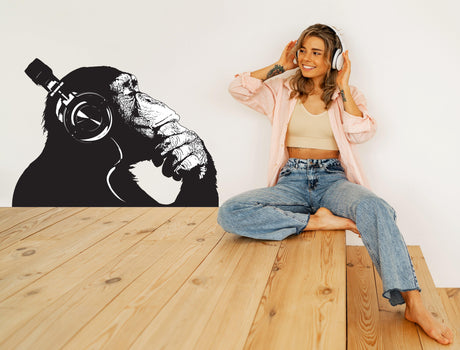
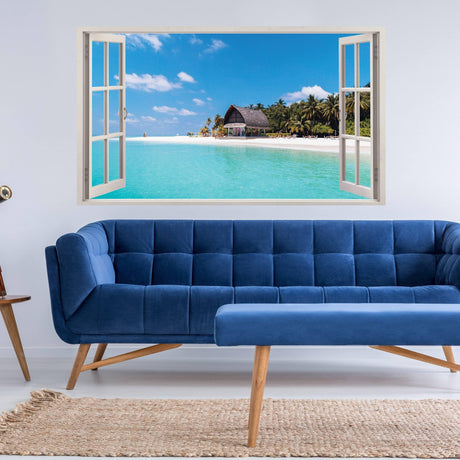
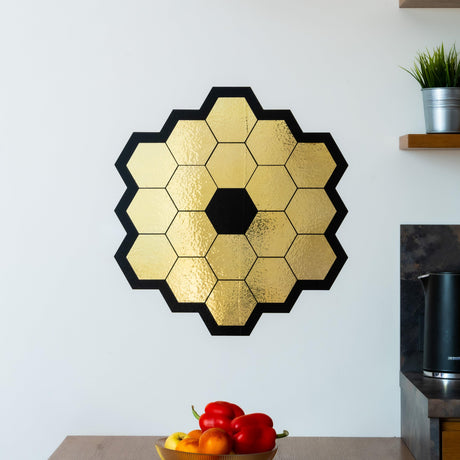
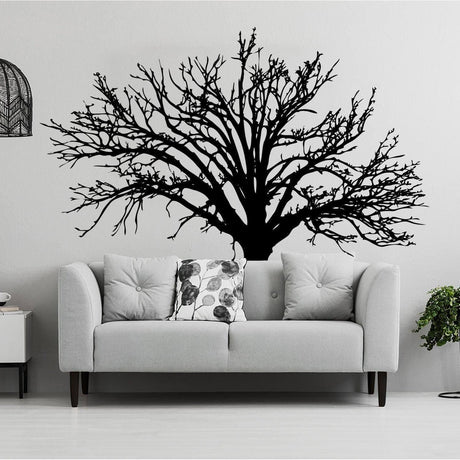
A large wall mural should be planned as part of the room rather than as an enlarged picture. This guide focuses on scale, crop, viewing position, furniture, focal details, lighting and the visual effect of panel joins. For material formats, multi-point measuring, wall preparation and installation, use the technical wall mural guide.
Define what the mural must do
| Purpose | Planning priority |
|---|---|
| Living-room focal wall | Relationship to the sofa, media unit and main seated viewpoint |
| Bedroom feature wall | Crop around the bed, headboard, lamps and calm viewing conditions |
| Office branding | Logo legibility, customer sightlines and authorised artwork |
| Retail or hospitality interior | Visibility from the entrance, circulation, furniture and maintenance access |
| Photography or event zone | Camera frame, subject position, lighting and temporary display period |
| Children’s room | Original age-appropriate artwork, furniture changes and placement away from reach |
Choose the feature wall from the main viewpoint
Stand at the room entrance and the position from which the mural will normally be seen. A technically large wall is not always the strongest choice. Doors, windows, tall furniture, glare and interrupted sightlines can weaken the composition. A smaller clear wall may produce a more coherent result.
Identify one primary viewpoint and any important secondary viewpoints. A perspective-heavy image may look convincing from one position and distorted from another.
Relate mural scale to the room
- Measure the usable wall rather than the complete architectural wall.
- Mark the proposed mural boundary with removable tape.
- Place furniture in its intended position.
- View the outline from the entrance and normal seating or standing point.
- Check whether the design needs open space around it or full-bleed coverage.
A mural can cover the complete feature wall or occupy a controlled central area. Full coverage creates stronger immersion, while partial coverage can preserve visual space and reduce conflict with furniture or lighting.
Match the image proportions to the wall
| Wall proportion | Artwork consideration |
|---|---|
| Wide panoramic wall | Landscape compositions, extended scenes and horizontal movement usually crop more naturally |
| Tall narrow wall | Vertical subjects and upward movement reduce aggressive side cropping |
| Square wall | Balanced central compositions provide more crop flexibility |
| Wall with a door or window | Important content must be positioned around the opening in the approved proof |
| Sloped ceiling or stair wall | The artwork needs a custom crop and access plan rather than a standard rectangle |
Do not stretch an image to fit a different proportion. Cropping, extending the background or selecting another artwork usually creates a better result than distortion.
Protect important content from seams and obstacles
Faces, text, logos, horizon lines and small focal objects should not fall on a vulnerable panel seam, corner, socket or furniture edge unless the proof deliberately allows it. Ask to see panel divisions on the scaled artwork before production.
- Move important faces away from joins.
- Keep text clear of corners and door frames.
- Check whether a sofa or headboard hides the lower image.
- Account for shelves, lamps, radiators and wall-mounted screens.
- Preserve quiet background areas where trimming may vary.
Judge image quality from the intended viewing distance
Large prints are not normally inspected from a few centimetres away. Assess resolution at final dimensions and the normal viewing distance. Fine detail that matters in a close-up photo may not be necessary for a mural viewed across a room, but compression artifacts and severe enlargement can still be visible.
Use the original file and approve the final crop. A screen preview confirms composition but does not guarantee exact physical sharpness or colour.
Plan colour and contrast under real lighting
Review the design in daylight and under the room’s evening lighting. Dark scenes can lose detail in a poorly lit corner. Very bright or high-contrast artwork can dominate a room intended to feel calm. Glossy finishes can show glare, while matte finishes often provide more consistent viewing across angles.
Consider the wall colour around a partial mural, as well as flooring, curtains and large furniture. Repeat a limited number of colours rather than attempting to match every item in the room.
Plan corners and connected walls
A mural continuing through a corner changes angle and scale. Decide whether the image should wrap continuously, end before the corner or use separate compositions. Avoid placing a face, logo or precise geometric object directly on the fold unless the proof shows the intended distortion.
Review the scaled proof as a room plan
The proof should show more than the image alone. Verify:
- wall and print dimensions;
- final crop and bleed;
- panel divisions;
- doors, windows and fixed obstacles;
- furniture height and likely covered areas;
- important text, faces and focal details;
- orientation and colour reference.
Plan installation access before production
Large panels need clean floor space, controlled support and safe access to the complete wall. Confirm whether furniture can be removed, whether two installers are required and whether stairs or high ceilings need specialist equipment. The technical wall mural format and installation guide covers surface preparation and panel sequence.
Plan how the room may change
A fixed mural can outlast furniture layouts, branding campaigns or children’s interests. For longer use, choose a crop that remains coherent if a sofa, bed or desk is replaced. For temporary projects, compare removable systems and review the wall compatibility and removal guide.
Frequently asked questions
Should a mural cover the complete wall?
Not always. Full coverage creates a continuous feature wall, while partial coverage can preserve negative space and avoid obstacles.
How do I know whether the mural is too large?
Mark the exact boundary, place the furniture and inspect it from the normal viewpoint. Room mock-ups are not exact measuring references.
Can important text cross a panel seam?
It can be technically possible, but critical text is usually easier to align and read when kept away from joins and corners.
Can one image continue around two walls?
Yes, with separate measurements and a proof that accounts for the corner and changed viewing angle.
How should artwork resolution be checked?
Use the original file and evaluate it at final physical dimensions and intended viewing distance.